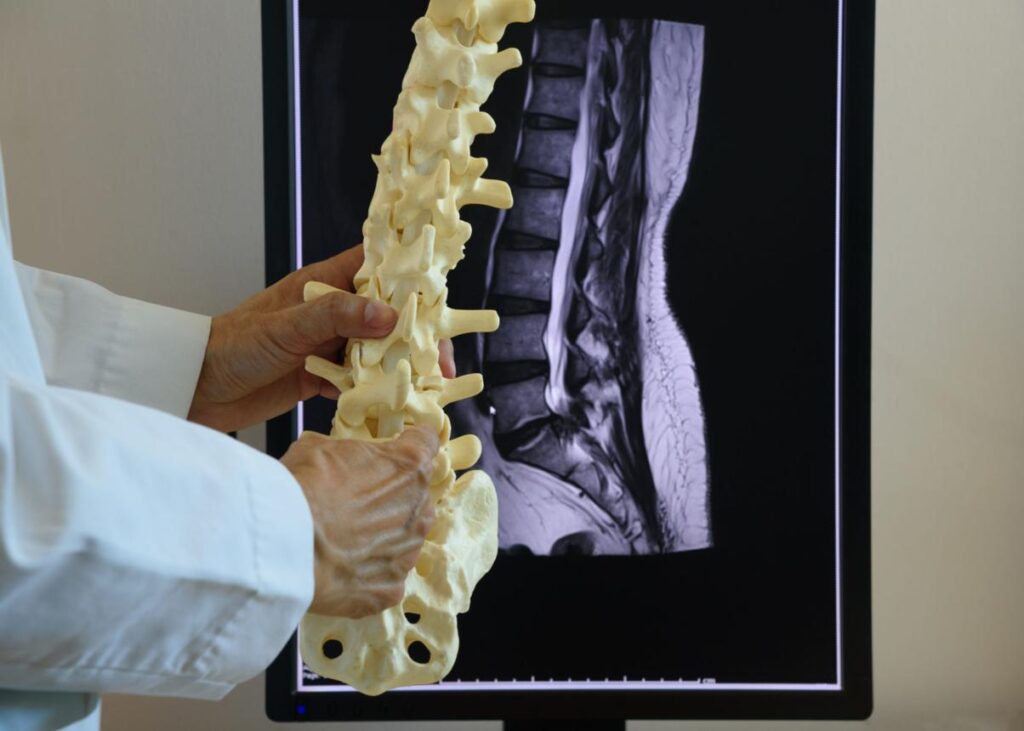
Understanding What the Science, Data, and Research Shows About Posterior Lumbar Fusion
Understanding When Fusion Is The Right Solution For Spinal Instability
Posterior lumbar fusion is a well-established procedure used to stabilize the spine, relieve pressure on nerves, and address structural problems such as instability or deformity.
Dr. Paul uses minimally invasive posterior fusion techniques when the patient’s condition requires both decompression and stabilization. The focus is not simply on performing surgery, but on identifying when fusion meaningfully improves outcomes compared to continued non-surgical care.
When Does Posterior Lumbar Fusion Make Sense?
Posterior lumbar fusion is most effective when there is a clear structural problem that cannot be corrected without stabilizing the spine. The strongest evidence supports its use in conditions such as degenerative spondylolisthesis, spinal instability, stenosis with instability, and selected cases of recurrent nerve compression.
This procedure is not designed for general low back pain. Outcomes are far more predictable when symptoms, physical findings, and imaging all point to a mechanical issue that requires stabilization.
In appropriately selected patients, fusion addresses both nerve compression and abnormal motion between vertebrae, which non-surgical treatments are unable to correct.
backed by data
How Does Fusion Compare To Continued Non-Surgical Treatment?
The strongest comparative evidence comes from patients with symptomatic degenerative spondylolisthesis. In long-term follow-up from the SPORT trial, patients who underwent surgery experienced significantly greater improvements in pain and function compared to those treated non-operatively.
These improvements were sustained for up to 8 years, demonstrating that surgery can provide durable results when the underlying issue is structural.
The data also shows that the specific fusion technique does not significantly change long-term outcomes. The most important factor is whether the surgery is addressing the correct problem.
What Determines A Successful Outcome?
Modern studies of minimally invasive posterior fusion techniques show that a majority of appropriately selected patients experience meaningful improvement in pain and function.
Outcomes are most predictable when surgery is addressing a clearly defined mechanical issue. Patients with instability-related pain, symptomatic spondylolisthesis, or recurrent nerve compression tend to have more reliable improvement than those with poorly localized back pain.
In practical terms, the literature supports fusion best when the indication is structural rather than generalized.
Understanding Risks And Long-Term Factors
Posterior lumbar fusion carries a different risk profile than decompression alone. In addition to standard surgical risks such as infection, bleeding, and nerve injury, fusion introduces considerations related to bone healing and implants.
Reported complication rates vary depending on technique. Studies of minimally invasive TLIF show complication rates around 9–10%, while some more recent analyses report rates closer to 4–5% in selected patient groups.
Fusion-specific risks include pseudarthrosis, where the bone does not fully heal. Reported rates are approximately 5.8%, with about 4.0% of patients requiring reoperation for this issue.
These numbers are important because they reflect real-world variability while still showing that most complications are manageable.
Looking For More Clarity On Your Condition? Schedule your appointment today.
The literature supports a clear principle. Posterior lumbar fusion works best when the problem is structural and when stabilization is necessary.
For highly indicated patients, surgery provides more reliable and durable improvement than non-surgical care alone. At the same time, it should not be viewed as a universal solution for back pain, as outcomes are far less predictable without a clear mechanical indication.
Long-term success depends not only on the procedure itself, but also on whether the fusion heals properly and remains stable over time.
When the diagnosis, symptoms, and surgical goal are aligned, fusion can be a highly effective and lasting treatment option.
Abdu WA, et al. Long-Term Results of Surgery Compared With Nonoperative Treatment for Lumbar Degenerative Spondylolisthesis in the SPORT Trial. Spine. 2018.
North American Spine Society. Diagnosis and Treatment of Degenerative Lumbar Spondylolisthesis.
Weiss H, et al. A Systematic Review of Complications Following Minimally Invasive Transforaminal
Lumbar Interbody Fusion. J Spine Surg. 2019.
Guo H, et al. Endoscopic TLIF versus MIS-TLIF: systematic review and meta-analysis. 2022.
Kalavacherla S, et al. A systematic review of pseudarthrosis and reoperation rates in minimally invasive adult spinal deformity surgery. 2024.
Degenerative Spondylolisthesis in the SPORT Trial. Spine. 2018.
North American Spine Society. Diagnosis and Treatment of Degenerative Lumbar Spondylolisthesis.
Prabhu, M. C., Jacob, K. C., Patel, M. R., Pawlowski, H., Vanjani, N. N., & Singh, K. (2022). History and Evolution of the Minimally Invasive Transforaminal Lumbar Interbody Fusion. Neurospine, 19(3), 479-491. https://doi.org/10.14245/ns.2244122.061
Quillo-Olvera, J., Soriano-Solis, S., Ortiz-Leyva, R. U., Gutiérrez-Partida, C. F., Rodríguez-García, M., & Soriano-Sánchez, J. A. (2015). MICROSURGICAL LANDMARKS IN MINIMALLY INVASIVE TRANSFORAMINAL LUMBAR INTERBODY FUSION. Coluna/Columna, 14(4), 317-319. https://doi.org/10.1590/s1808-185120151404152838 Cited by: 9
Tsahtsarlis, A., & Wood, M. (2012). Minimally invasive transforaminal lumber interbody fusion and degenerative lumbar spine disease. European Spine Journal, 21(11), 2300-2305. https://doi.org/10.1007/s00586-012-2376-y
Weinstein, J. N., Lurie, J. D., Tosteson, T. D., Hanscom, B., Tosteson, A. N., Blood, E. A., Birkmeyer, N. J., Hilibrand, A. S., Herkowitz, H., Cammisa, F. P., Albert, T. J., Emery, S. E., Lenke, L. G., Abdu, W. A., Longley, M., Errico, T. J., & Hu, S. S. (2007). Surgical versus Nonsurgical Treatment for Lumbar Degenerative Spondylolisthesis. New England Journal of Medicine, 356(22), 2257-2270. https://doi.org/10.1056/nejmoa070302 Cited by: 1206
Weinstein, J. N., Lurie, J. D., Tosteson, T. D., Zhao, W., Blood, E. A., Tosteson, A. N., Birkmeyer, N., Herkowitz, H., Longley, M., Lenke, L., Emery, S., & Hu, S. S. (2009). Surgical Compared with Nonoperative Treatment for Lumbar Degenerative Spondylolisthesis. The Journal of Bone and Joint Surgery-American Volume, 91(6), 1295-1304. https://doi.org/10.2106/jbjs.h.00913 Cited by: 778