Understanding What the Science, Data, and Research Shows About Anterior Cervical Discectomy & Fusion (ACDF)
When This Procedure Is Used And What It Treats
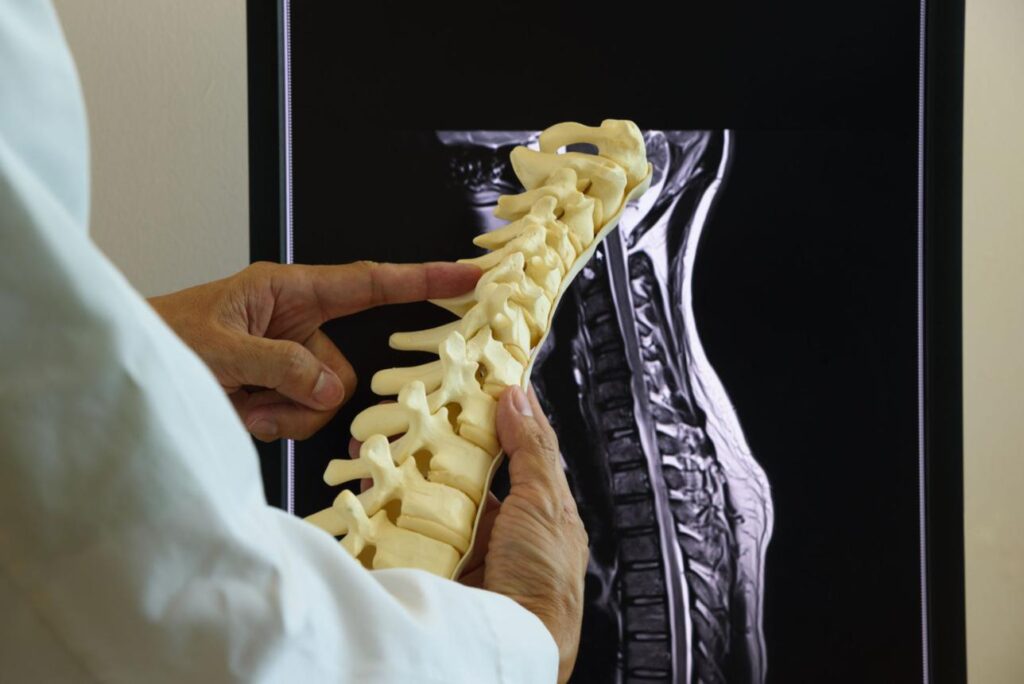
Anterior cervical discectomy and fusion (ACDF) is one of the most well-established procedures in spine surgery. It is commonly used to treat cervical radiculopathy and cervical myelopathy caused by herniated discs, bone spurs, or degenerative narrowing in the neck.
Dr. Paul performs ACDF using a modern, tissue-respecting approach designed to relieve pressure on nerves or the spinal cord while stabilizing the affected level. When the diagnosis, symptoms, and imaging are aligned, this procedure has a long track record of providing meaningful and reliable improvement.
When Is ACDF Most Effective?
ACDF is most effective when there is a clearly defined structural source of nerve root or spinal cord compression. The best outcomes are typically seen in patients with persistent arm pain, numbness, weakness, or coordination issues that have not improved with appropriate non-surgical care.
It is also commonly used in cases of cervical myelopathy, where spinal cord compression can affect balance, coordination, and overall function.
A key factor is alignment between symptoms, physical exam findings, and imaging. When these all point to the same level and cause, the likelihood of meaningful improvement is significantly higher.
Randomized studies by Engquist and colleagues provide some of the strongest comparative data for cervical radiculopathy.
These studies showed that patients treated with ACDF plus physiotherapy improved faster and had greater reductions in neck pain compared to those treated with physiotherapy alone during the first year.
At longer-term follow-up of 5 to 8 years, more than 90% of surgical patients reported that they were at least “better,” compared to approximately 60% of patients treated non-surgically.
This highlights an important point. Many patients can improve without surgery, but in properly selected patients, ACDF provides faster relief and a higher likelihood of long-term improvement.
What Results Can Patients Expect?
ACDF has consistently strong outcomes when used for the right indication. Across modern studies, most patients experience substantial improvement in arm pain, neurologic symptoms, and overall function.
Fusion rates are generally high, particularly in single-level procedures. Outcomes are influenced by factors such as smoking status, bone quality, and the number of levels treated.
In practical terms, most patients improve significantly, and many experience a high degree of symptom relief when the procedure is matched to the correct diagnosis.
Understanding Risks And Recovery Considerations
ACDF is generally considered a safe and reliable procedure, but it does carry risks.
The most common short-term issue is difficulty swallowing, known as dysphagia. Studies report an overall rate of approximately 8.5%, with moderate or severe cases occurring in about 4.4% of patients.
A 2024 review reported additional complication rates, including pseudarthrosis at approximately 5.8% and adjacent segment disease at about 8.8%.
Most of the symptoms patients notice early after surgery, such as swallowing difficulty or mild voice changes, are temporary and improve over time. Serious complications are uncommon, particularly when the procedure is performed in appropriately selected patients.
Want To Better Understand Your Treatment Options? Schedule your appointment today.
The research supports a clear principle. ACDF works best when there is a defined structural source of nerve or spinal cord compression that matches the patient’s symptoms.
For patients with persistent cervical radiculopathy ormyelopathy who have not improved with non-surgical care, the procedure offers a high likelihood of meaningful and lasting improvement.
At the same time, it is not necessary for every neck condition. Many patients improve with conservative care, and surgery is typically reserved for those with ongoing symptoms or progressive neurologic findings.
When the diagnosis, symptoms, and surgical goal are aligned, ACDF remains one of the most dependable and well-supported procedures in spine surgery.
References
1. North American Spine Society. Diagnosis and Treatment of Cervical Radiculopathy from Degenerative Disorders. Clinical Guideline. https://www.spine.org/Portals/0/assets/downloads/researchclinicalcare/guidelines/cervicalradiculopathy .pdf 2. Engquist M, Löfgren H, Öberg B, et al. Surgery versus nonsurgical treatment of cervical radiculopathy: a prospective, randomized study with a 2-year follow-up. Spine (Phila Pa 1976). 2013;38(20):1715-1722. https://pubmed.ncbi.nlm.nih.gov/23778373/ 3. Engquist M, Löfgren H, Gerdhem P, et al. A 5- to 8-year randomized study on the treatment of cervical radiculopathy: anterior cervical decompression and fusion plus physiotherapy versus physiotherapy alone. J Neurosurg Spine. 2017;26(1):19-27. https://pubmed.ncbi.nlm.nih.gov/27564856/ 4. Shriver MF, Lewis DJ, Kshettry VR, Rosenbaum BP, Benzel EC, Mroz TE. Dysphagia rates after anterior cervical diskectomy and fusion: a systematic review and meta-analysis. Global Spine J. 2017;7(1):95-103. https://pmc.ncbi.nlm.nih.gov/articles/PMC5400168/ 5. Rai V, et al. A systematic review of risk factors and adverse outcomes associated with anterior cervical discectomy and fusion. J Clin Orthop Trauma. 2024. https://journals.lww.com/jcjs/fulltext/2024/15020/a_systematic_review_of_risk_factors_and_adverse.3. aspx 6. PaulSpine.com. Anterior Cervical Fusion. https://paulspine.com/