Lumbar Disc Bulge: Understanding a Common MRI Finding and When It Actually Requires Attention
Understanding a Common MRI Finding and When It Actually Requires Attention
A lumbar disc bulge is one of the most common findings on spine imaging—and in most cases, it is a normal part of aging rather than a serious condition.
Dr. Paul focuses on helping patients accurately interpret imaging results, separating what is clinically meaningful from what is simply descriptive. Most disc bulges do not require treatment and can be managed with simple lifestyle strategies and reassurance.
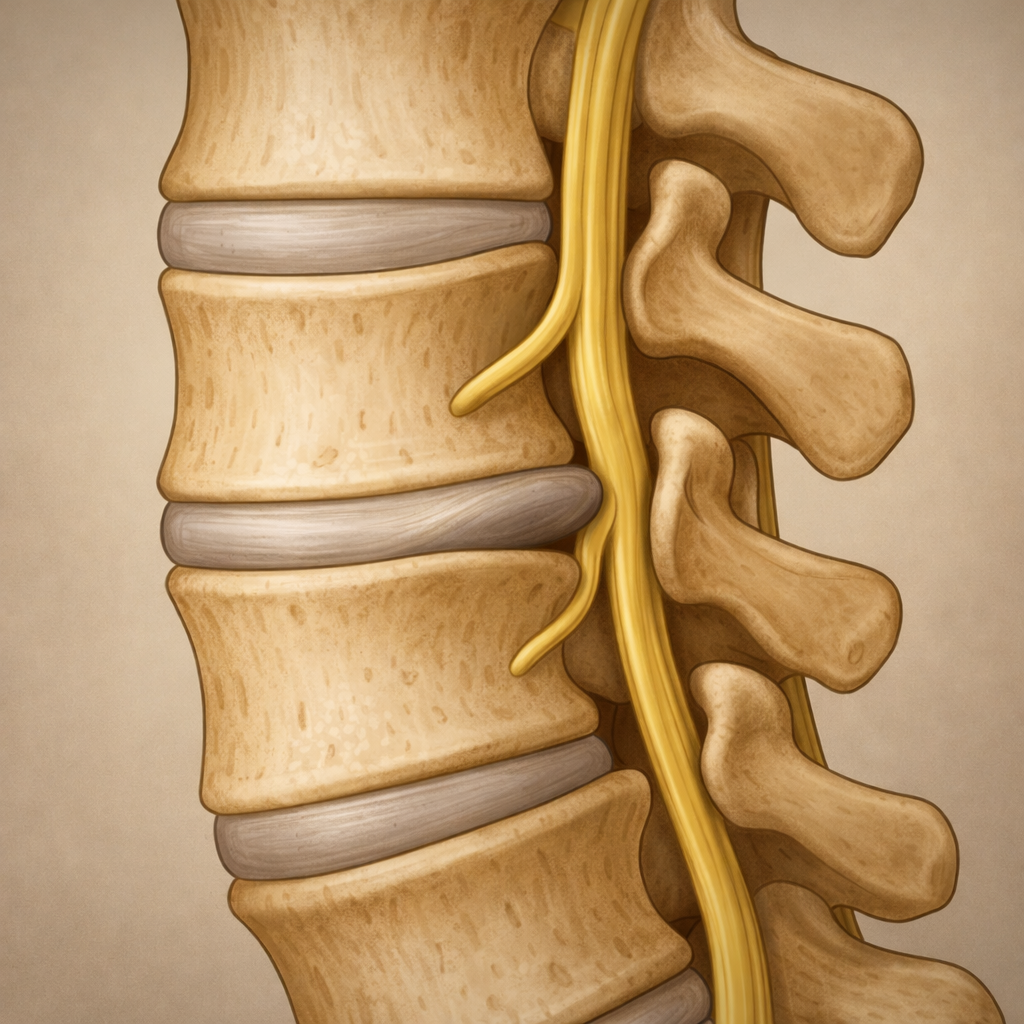
The discs in the lower spine naturally change over time as they lose hydration and elasticity. This can cause the disc to slightly extend beyond its normal boundaries, a finding referred to as a disc bulge.
Unlike a herniated disc, a bulge does not involve a tear in the outer layer and typically does not compress nearby nerves. Imaging studies have shown that disc bulges are extremely common, with more than half of adults over 40 demonstrating this finding—even in the absence of pain.
Recognizing this distinction is essential to avoid unnecessary concern or treatment based solely on imaging results.
Symptoms
Most lumbar disc bulges are completely asymptomatic and are not the source of back pain.
However, evaluation may be needed if symptoms include:
These symptoms may indicate nerve involvement, which requires further assessment—not the bulge itself, but what it may be affecting.
How to Interpret MRI Results
MRI reports often include terms that sound concerning but are typically descriptive of normal aging. Findings such as disc bulges, degenerative disc changes, and small annular fissures are extremely common and do not necessarily indicate a source of pain.
These findings must always be interpreted in the context of symptoms and clinical evaluation. Treating imaging alone without considering how a patient feels often leads to unnecessary interventions.
Because most disc bulges are not harmful, treatment focuses on maintaining spinal health and function rather than correcting the imaging finding itself. Regular movement, strength, and proper mechanics play a central role in long-term spine health.
Low-impact exercise, proper posture, and ergonomic habits help reduce unnecessary strain on the spine, while maintaining a healthy weight and avoiding smoking support overall disc health.
A lumbar disc bulge means the disc is extending slightly beyond its usual boundary. In many adults, this is a common age-related finding and does not automatically mean there is a dangerous problem or that the bulge is causing pain.
Q: Is a lumbar disc bulge the same as a herniated disc?
Not exactly. A bulge is usually broad and mild, while a herniation is more focal and more likely to irritate a nerve. Radiology terms can sound alarming, but the clinical significance depends on symptoms and physical examination.
Q: Can a disc bulge be completely normal?
Yes. Disc bulges are often found in people who have no back pain at all. They are extremely common on MRI reports, especially as people get older, which is why a scan result must always be interpreted in context.
Q: Why do radiology reports make disc bulges sound serious?
Radiology reports are designed to describe anatomy in detail, not to tell you whether a finding is dangerous. A report may list every structural change, even when those changes are common, stable, and unrelated to the reason you hurt.
Q: Can a lumbar disc bulge cause back pain or sciatica?
Sometimes it can, especially if it contributes to inflammation or narrows space around a nerve root. However, many bulges are incidental findings, so the real question is whether the MRI matches the symptoms and exam.
Q: What is the best treatment for a lumbar disc bulge?
Most people do best with movement, core strengthening, walking, posture improvement, and avoiding fear-driven inactivity. Short-term medication or physical therapy can help, but prolonged bed rest usually makes recovery slower rather than faster.
Q: Do I need surgery for a lumbar disc bulge?
Surgery is rarely based on a disc bulge alone. It is considered only when there is true nerve compression with persistent pain, progressive weakness, or other significant neurologic symptoms that do not improve with appropriate conservative care.
Q: What is the most important takeaway about a disc bulge?
A disc bulge is often a description, not a diagnosis. For many patients it is part of normal aging, not a sign of damage or danger, and it should not be used by itself to predict pain, disability, or the need for surgery.
Not Sure If This Is What You’re Experiencing? Schedule an Appointment Today.
1. Brinjikji W, et al. MRI Findings of Disc Degeneration Are More Common in Adults Without Back Pain Than With Back Pain. AJNR Am J Neuroradiol. 2015. 2. Dydyk AM, et al. Lumbar Disc Herniation. StatPearls [Internet]. NCBI Bookshelf; updated 2024. 3. Kreiner DS, et al. NASS Evidence-Based Clinical Guidelines for Lumbar Disc Pathology. North American Spine Society, 2022. 4. Borenstein DG. The Natural History of Low Back Pain. Curr Rev Musculoskelet Med. 2013. 5. National Spine Health Foundation. Spinal Health Education Resources. 2024.