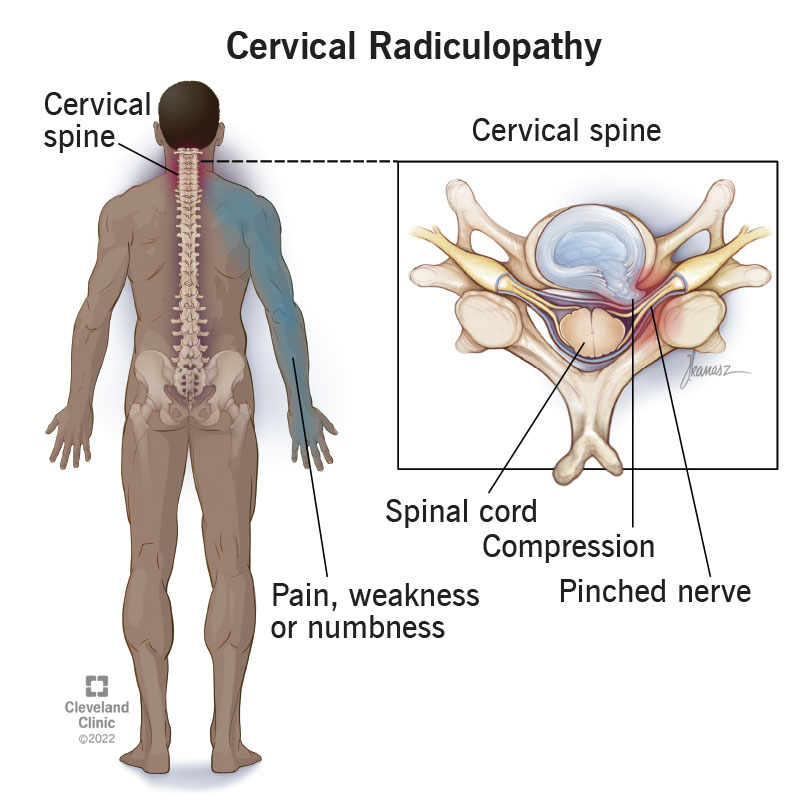
Cervical radiculopathy, commonly referred to as a “pinched nerve in the neck,” occurs when a nerve root becomes compressed or inflamed. This often leads to pain radiating into the shoulder, arm, or hand, along with numbness, tingling, or weakness.
Most patients improve with structured, evidence-based care. Cervical radiculopathy affects approximately 85 per 100,000 people annually, and the majority of individuals recover without surgery.
Patients typically experience radiating arm pain, numbness or tingling in the hand or fingers, and in some cases weakness in the arm or grip. Symptoms are often worsened by certain neck movements and may fluctuate depending on activity and posture.
Underlying Causes
Cervical radiculopathy is most commonly caused by structural changes in the cervical spine.
These include disc herniation, cervical spondylosis (arthritis), bone spur formation, and degenerative disc disease. Each of these conditions can narrow the space around a nerve root, leading to irritation or compression.
Diagnostic Evaluation
Diagnosis is based on a careful correlation of symptoms, physical examination findings, and imaging studies. During the clinical exam, strength, reflexes, and nerve patterns are evaluated to identify the affected nerve root.
MRI is typically used to confirm nerve compression and visualize soft tissue structures. X-rays help assess spinal alignment and degenerative changes, while EMG testing may be used selectively to rule out other neurologic conditions when the diagnosis is unclear.
Non-Operative Management
Most patients improve with conservative, non-operative care. Studies show that approximately 75 to 90 percent of individuals recover within several months without the need for surgery.
Treatment typically begins with physical therapy focused on postural correction, strengthening, and improving mobility. Medications such as anti-inflammatory drugs, short courses of steroids, or nerve pain medications may be used to reduce symptoms. For patients with persistent pain, targeted injections such as cervical epidural or selective nerve root injections can provide relief.
Activity modification also plays an important role, including ergonomic adjustments, reducing repetitive strain, and maintaining overall physical health.
Surgical Treatment Options
Anterior Cervical Discectomy and Fusion (ACDF)
Anterior cervical discectomy and fusion is a well-established procedure that removes the damaged disc, relieves pressure on the nerve, and stabilizes the spine through fusion.
Cervical Disc Arthroplasty (Disc Replacement)
Cervical disc replacement is a motion-preserving alternative that replaces the damaged disc while maintaining movement at the treated level. This option is typically appropriate for carefully selected patients with less advanced degeneration.
Reconstruction Strategy: Motion Preservation vs Stabilization
Both procedures are effective at relieving nerve compression. The primary difference lies in how the spine is reconstructed. Fusion provides stability by eliminating motion at the affected level, while disc replacement preserves motion and may reduce stress on adjacent segments.
When to Seek Evaluation
Patients should consider evaluation if they experience persistent arm pain, numbness, or weakness, particularly if symptoms last several weeks or begin to worsen over time. Early evaluation can help clarify the diagnosis and guide the most effective treatment plan.